The short answer: Grooming fear is learned — from rushed handling, restraint, loud dryers, pain (often from mats or nicks), or simply too much, too fast, too young. Which means it can be un-learned, through the same door it came in: many small, safe, positive experiences that never push past the dog's threshold. At home that looks like short desensitization sessions with real rewards. Professionally, it looks like slower appointments, one familiar person, consent-based handling, and the willingness to end a session early. What it never looks like: "just holding them down until it's done."
Some of my favorite clients arrived shaking. Dogs who'd been kicked out of salons, dogs who hid when the brush drawer opened, dogs whose owners apologized for them before I'd even said hello. So let me say the most important thing first: your dog isn't bad, dramatic, or stubborn. Your dog is scared. Fear is not disobedience, and it doesn't respond to being overpowered — it responds to safety, repeated until it's believed.
Why dogs fear grooming (it's more rational than it looks)
From the dog's side, traditional grooming is a strange gauntlet: taken from you, often caged, surrounded by unfamiliar dogs and smells, restrained on a high table, sprayed with water, blasted with a dryer that sounds like a jet engine, and handled on the most sensitive parts of their body — feet, ears, tail, face — by a stranger working on a schedule. A dog doesn't need a "bad groomer" to come out of that anxious. The format itself is a lot.
Add any of these and fear compounds:
- Pain associations. Dematting a neglected coat hurts. A quicked nail hurts. One painful session can poison years of them.
- Restraint panic. Some dogs escalate specifically when held still — restraint itself becomes the trigger.
- Dryer terror. For sound-sensitive dogs, high-velocity dryers are the single scariest element in grooming.
- No early exposure. Dogs who weren't gently handled — paws, ears, mouth — as puppies meet all of it for the first time as adults, when everything new is scarier.
- One bad day. Dogs generalize fast from single events. One nick, one slip on a wet table, one rough handler.
Understanding the specific trigger matters, because the fix is trigger-specific. A dryer-phobic dog and a restraint-panicked dog need different plans.
The home program: desensitization and counter-conditioning, minus the jargon
Two ideas power everything below. Desensitization: exposure to the scary thing at an intensity so low it doesn't trigger fear, gradually increased. Counter-conditioning: pairing that low-level exposure with something genuinely great (real food — chicken, cheese, not kibble) so the emotional association flips from "threat" to "predicts good things."
The cardinal rule: stay under threshold. If your dog is stiff, lip-licking, yawning, showing whale eye (whites visible), tucking their tail, or trying to leave — you've gone too far, too fast. Back up to the last easy step. Progress that feels embarrassingly slow is the correct speed.
A sample brush program (adapt the same structure for nail clippers, dryers, or bath setups):
- Brush appears, treats happen, brush goes away. That's the whole session. 30 seconds, a few times a day.
- Brush touches the dog's shoulder — not brushing, just touching. Treat. Remove. Repeat until the touch makes them look for the treat.
- One single stroke on the least sensitive area (usually shoulder or back). Treat. Done.
- Two strokes. Three. Sessions stay under two minutes. Always end before the dog wants to.
- Gradually add areas — chest, sides, hindquarters, and much later, tail, feet, ears, face. Each new area starts back at step 2.
- Add duration last. A dog who happily accepts 30 seconds everywhere beats a dog who tolerates 10 minutes somewhere.
For dryer fear specifically: start with the dryer visible and OFF (treats), then on in another room, then on at lowest setting across the room pointed away, then closer over many sessions, then briefly touching air to the dog's rear (never the face). Some dogs also do dramatically better with a happy hoodie / snood over the ears, or with towel-plus-air-drying instead of full force drying — and a good groomer will honor that. Between sessions, adequate brushing and a correct bath routine keep the coat manageable so no appointment ever requires heroics.
Two things to add to the toolkit: a lick mat smeared with something wonderful, stuck to the tub wall (licking is self-soothing and keeps the head busy), and handling exercises during couch time — touching paws, holding a nail, lifting an ear, always paired with food, always brief. Dogs who accept handling accept grooming. Ask me for my current favorite comfort gear while that recommendation list is offline.
What comfort-first professional grooming looks like
When you're evaluating a groomer for an anxious dog — me or anyone else — here's what the real thing looks like:
- One person, start to finish. Anxious dogs attach to a handler within a session. Being passed between bather, dryer, and finisher resets trust every time. (In my mobile spa it's structurally one person — me — which is half the reason anxious dogs are my niche.)
- No cages, no waiting in a room of barking strangers. The pre-appointment environment can spend a dog's entire stress budget before grooming starts.
- A slower schedule. Comfort-first appointments take longer, full stop. If a groomer's booking model doesn't allow it, the dog pays the difference.
- Consent-based handling. The dog gets breaks, gets to move, gets a say. Handling pressure goes down when stress goes up — not the reverse.
- Willingness to do less. Sometimes the right session is a bath and six nails, done calmly, with the rest next time. A groomer who'd rather finish the haircut than protect the dog's progress is optimizing for the wrong thing.
- Honest reporting. You should hear exactly what happened, what your dog struggled with, and what the plan is — not just "he did fine!"
And a boundary worth knowing: grooming fear vs. clinical anxiety. If your dog panics at low-level triggers, can't take food when stressed (a red flag that they're over threshold), shows aggression, or has anxiety that spills across daily life, loop in your veterinarian — possibly a veterinary behaviorist. There are dogs who genuinely benefit from vet-prescribed pre-visit medication, and using it isn't a failure; it's often the bridge that lets counter-conditioning finally work. Groomers don't prescribe, recommend doses, or suggest you borrow a sedative — anyone who does is practicing medicine without a license on your dog.
What I do differently with anxious dogs (so you know what to ask any groomer for)
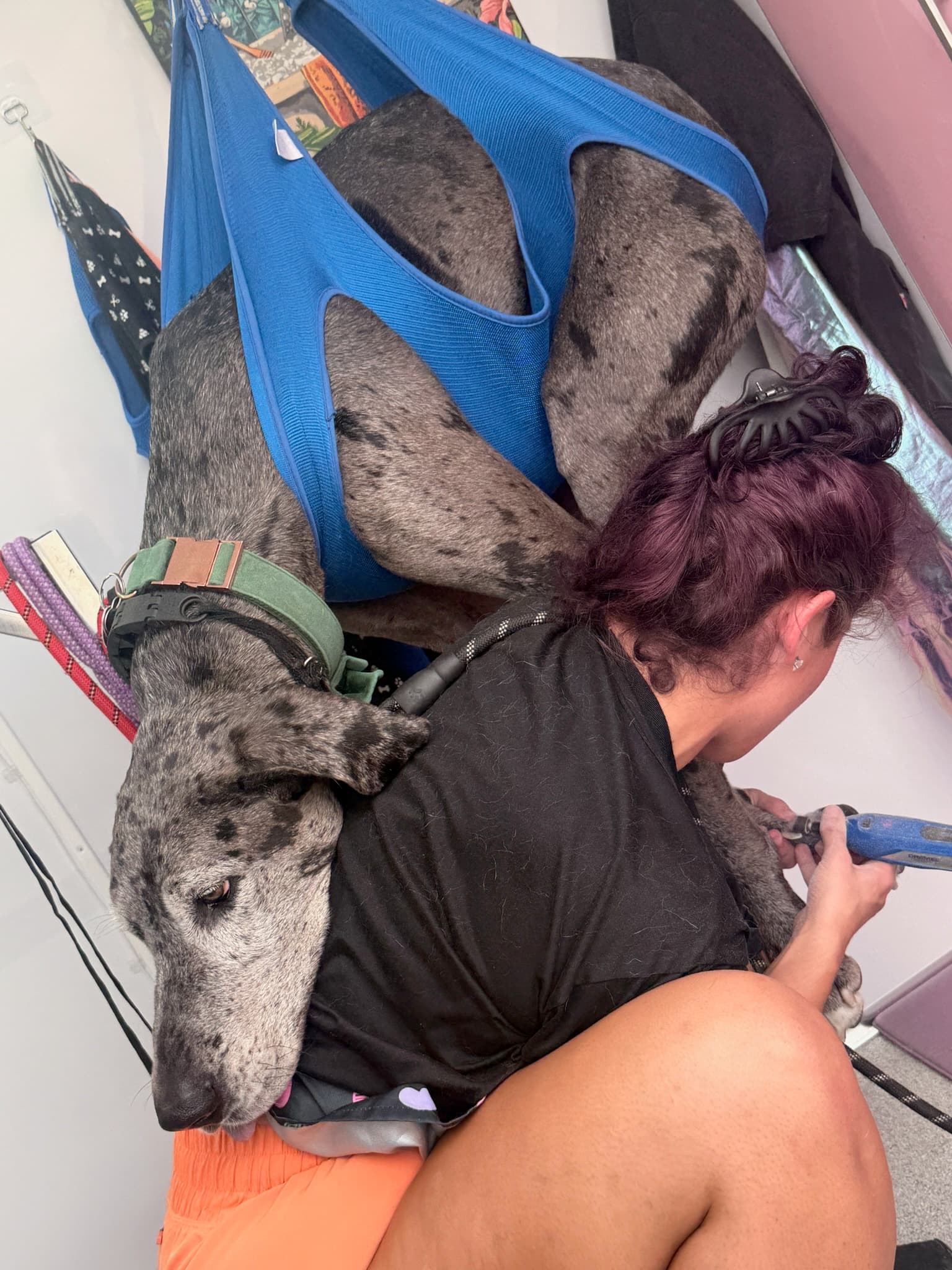
The first visit with a fearful dog often accomplishes "less grooming" than owners expect — and more progress than they've had in years. A typical arc: the consultation happens with your dog present but nothing required of them. First session, we do whatever your dog can genuinely handle — sometimes a full gentle bath, sometimes fifteen minutes of treats and warm water on feet. Every session ends on a win, gets documented with notes and photos, and the next one starts further along. Within a few visits, most dogs walk up the van steps voluntarily. That moment — the voluntary walk-up — is the actual product. The haircut is downstream of it.
Frequently asked questions
How long does it take to rehabilitate grooming fear? Weeks to months, honestly — it depends on the fear's depth, the dog's age and temperament, and consistency at home. Most dogs show meaningful change within 3–5 comfort-first sessions plus daily micro-sessions at home. Deeply traumatized dogs take longer, and that's okay; they didn't get scared in a day either.
Should I stay with my dog during grooming? It depends on the dog — some settle better with you present, and some perform their stress for you and settle faster once you step away. A good groomer will experiment with both and tell you honestly which worked. Don't take "owners always make it worse" at face value; don't insist on staying if the evidence says otherwise, either.
My dog was banned from a salon. Is that a lost cause? Not remotely. "Banned" usually means the dog's needs exceeded a high-volume format — not that the dog is ungroomable. One-on-one, slower-paced settings recover a large share of these dogs.
Treats don't work — my dog won't eat during grooming. Now what? A dog who refuses food they normally love is over threshold — too scared to eat. That's not "treats don't work," it's "we're starting too big." Scale down until food works again, and if it never does even at tiny intensities, that's the sign to talk to your vet about additional support.
Is it too late to start this with a senior dog? No — seniors learn the same way, just factor in their physical comfort too. Arthritis can make handling genuinely uncomfortable rather than just scary, which is its own topic: see Senior Dog Skin & Coat Care.
Sources & further reading
- Fear Free Happy Homes — "Headed to the Groomer? You've Got Homework"
- American Veterinary Society of Animal Behavior — position statements and handouts
- American Kennel Club — desensitization and counter-conditioning basics
Educational content from professional grooming experience — not veterinary or behavioral medicine advice. Dogs with severe anxiety or any aggression history should be evaluated by a veterinarian or veterinary behaviorist.